Last Tuesday, I typed our brand name into ChatGPT. Not a complex prompt. Just: “What tools help with [our category]?”
We weren’t mentioned. Not once. Three competitors were. Two of them had smaller audiences than us.
That stung. But it also raised a question I couldn’t answer: How long had we been invisible?
We had no baseline. No record. No way to know if this was new or if AI had been ignoring us for months.
That’s where most small teams are right now. Not behind on strategy — behind on awareness.
You can’t fix what you can’t see.
By the end of this guide, you’ll have a working system to track whether AI platforms are surfacing your content — using tools you probably already have, in under two hours per week.
Before You Start: The Pre-Flight Check
This guide isn’t for everyone yet. It’s for teams that have already published content consistently for at least a few months and have Google Search Console connected to their site.
If you’re still building your first batch of blog posts, bookmark this and come back.
Tracking visibility before you have content to track is like checking your rearview mirror in a parked car.
Your Stop/Go test: Can you name three pieces of content on your site that already rank for something — anything — in Google Search Console?
If yes, you’re ready. Let’s go.
Phase 1: Understand What AI Visibility Actually Means
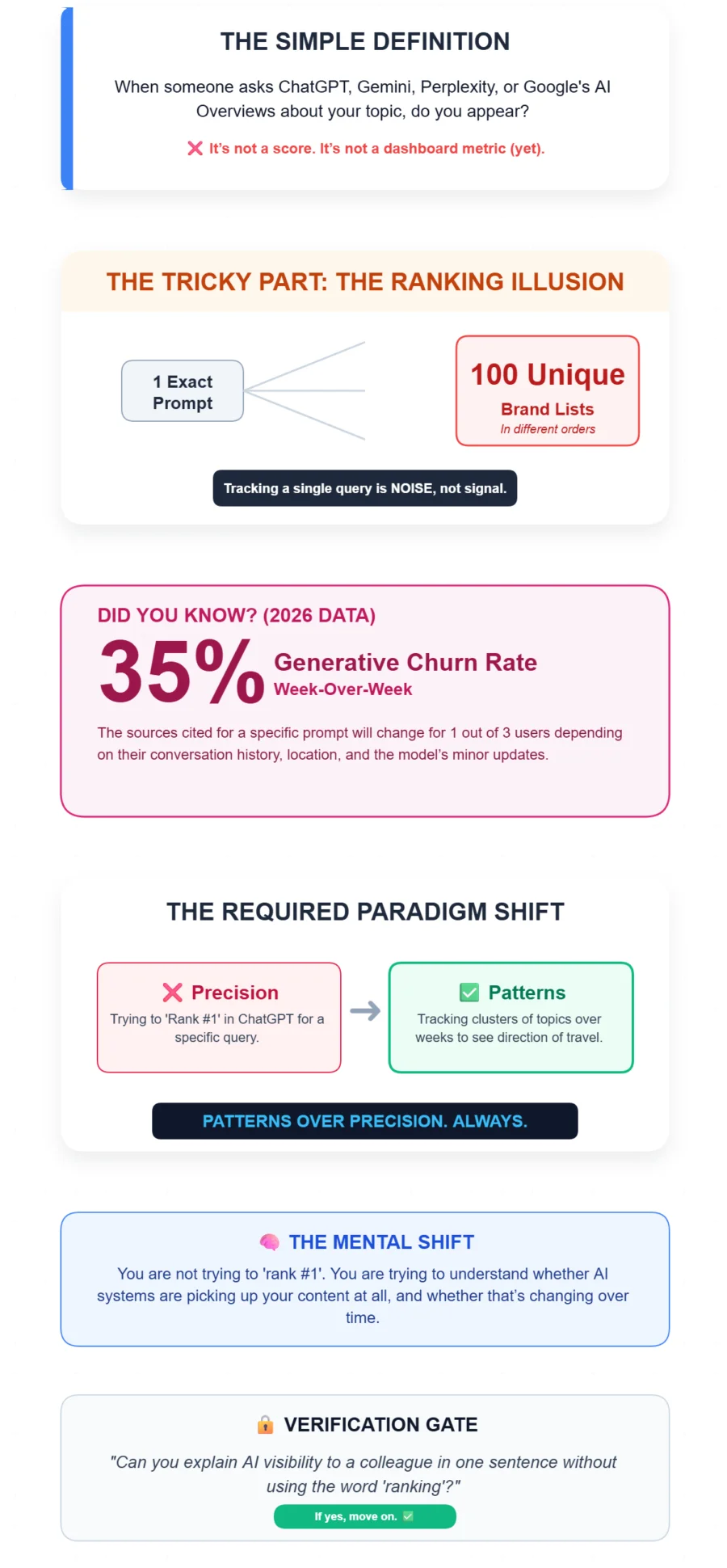
AI visibility is whether your brand, your content, or your website shows up when someone asks an AI tool a question related to your space.
That’s it. It’s not a score. It’s not a dashboard metric (yet, for most of us).
It’s a simple question: When someone asks ChatGPT, Gemini, Perplexity, or Google’s AI Overviews about your topic, do you appear?
The tricky part: this isn’t like traditional search rankings. SparkToro’s research revealed something uncomfortable — asking the same prompt 100 times can produce roughly 100 unique brand lists in different orders.
Individual prompt rankings are, for practical purposes, random.
So tracking a single query and celebrating when you show up? That’s noise, not signal.
What you need instead are patterns. Patterns across many prompts, tracked over weeks, that tell you whether your direction of travel is positive or negative.
Patterns over precision. Always.
What you should see at this point: A mental shift. You’re not trying to “rank #1 in ChatGPT.”
You’re trying to understand whether AI systems are picking up your content at all, and whether that’s changing over time.
Verification: Can you explain AI visibility to a colleague in one sentence without using the word “ranking”?
If so, move on.
📉 The Generative Churn Rate
Did you know? In 2026, AI search models experience a 35% “generative churn” week over week. This means the sources cited for a specific prompt will change for 1 out of 3 users depending on their conversation history, location, and the model’s minor updates. This is why tracking a single prompt is useless—you must track clusters of topics.
Phase 2: Set Up Your Tracking Signals (The Practical Stuff)
Here’s where most guides lose small teams. They jump straight to specialized tools costing hundreds per month.
We’re not doing that.
Semrush’s guidance on AI visibility tracking for small teams makes a point worth repeating: you don’t need an enterprise stack to understand visibility shifts.
They recommend starting with impressions trends in Google Search Console, watching for branded search growth, and doing periodic manual checks in AI search tools.
This approach builds what I’d call a “visibility signal” — a directional indicator that tells you whether AI systems are surfacing your content, even if clicks aren’t rising proportionally.
Here’s your starter checklist:
Signal 1: GSC Impressions (Weekly)
Open Google Search Console. Go to Performance. Filter by the last 28 days and compare to the previous 28 days.
You’re looking at impressions, not clicks. Why? Because AI Overviews and generative search results often show information without generating a click.
Your impressions might climb while clicks stay flat. That’s not a failure — it’s a zero-click signal that your content is being referenced.
What you should see: A comparison view showing two trend lines.
If impressions are rising but clicks are flat or declining slightly, that’s a pattern worth noting — not panicking about.
Signal 2: Branded Search Volume (Monthly)
Still in GSC, filter queries for your brand name. Are more people searching for you by name?
This is a proxy metric. When AI tools mention your brand, some users will Google you directly afterward.
A slow, steady rise in branded queries — even 10-15% over a quarter — can signal that AI platforms are increasing your exposure.
Signal 3: Manual AI Checks (Bi-Weekly)
This one’s unglamorous but powerful. Every two weeks, open ChatGPT, Gemini, and Perplexity.
Type 4-6 prompts related to your core topics. Screenshot the results.
Keep a simple spreadsheet:
| Date | Platform | Prompt | Mentioned? (Y/N) | Position (if applicable) | Notes |
|---|---|---|---|---|---|
That’s your evidence log. Timestamped. Exportable. No fancy tool required.
Friction warning: Individual query results are volatile. You might show up on Monday and vanish on Wednesday.
That’s normal — remember the prompt diversity problem. Don’t react to single checks.
React to patterns across 8-12 checks over a month.
Verification: After your first round of manual checks, you should have at least 4 screenshots saved and one row filled in your spreadsheet.
If you do, Phase 2 is done.
Phase 3: Pick One Lightweight Tool (Not Seven)
Semrush’s review of AI visibility tools groups solutions into categories like generative search checkers, AI answer extraction tools, and search performance dashboards.
That’s useful framing because it tells you types of help exist — not that you need all of them.
For a small team, pick one tool that answers one specific question.
The question to answer first: “Is our content being sourced in AI summaries?”
If a tool answers that — even imperfectly — it’s worth testing. Many platforms offer freemium tiers. Start there.
Validate the concept before committing budget.
Here’s what to watch for when evaluating:
- Does it cover more than one AI engine? Tools covering only ChatGPT miss roughly 40% of AI traffic coming from Gemini and Perplexity. Multi-platform monitoring matters, even at a basic level.
- Does it show cited pages? Knowing which pages get referenced is more actionable than a single visibility score. Your top cited pages drive a disproportionate share of AI visibility — knowing which ones lets you double down.
- Does it update frequently enough? Some hybrid tools that combine SEO and AI visibility have slower update frequencies. If competitive shifts happen weekly, monthly data won’t cut it.
One tool. One question. That’s the whole play for now.
Building content that AI actually wants to cite?
That’s where the writing itself matters. ButterBlogs combines topic research, keyword analysis, and SEO optimization to help small teams create the kind of long-form, authoritative content that AI systems tend to surface. If your tracking reveals gaps, your content pipeline is the first place to fix.
What you should see: A single tool installed or bookmarked, with your brand and 2-3 competitors entered for tracking.
Nothing more.
Verification: Can you log into one tool and see at least a directional indicator of your AI visibility compared to one competitor?
If yes, move forward.
Phase 4: Build Your Weekly Rhythm
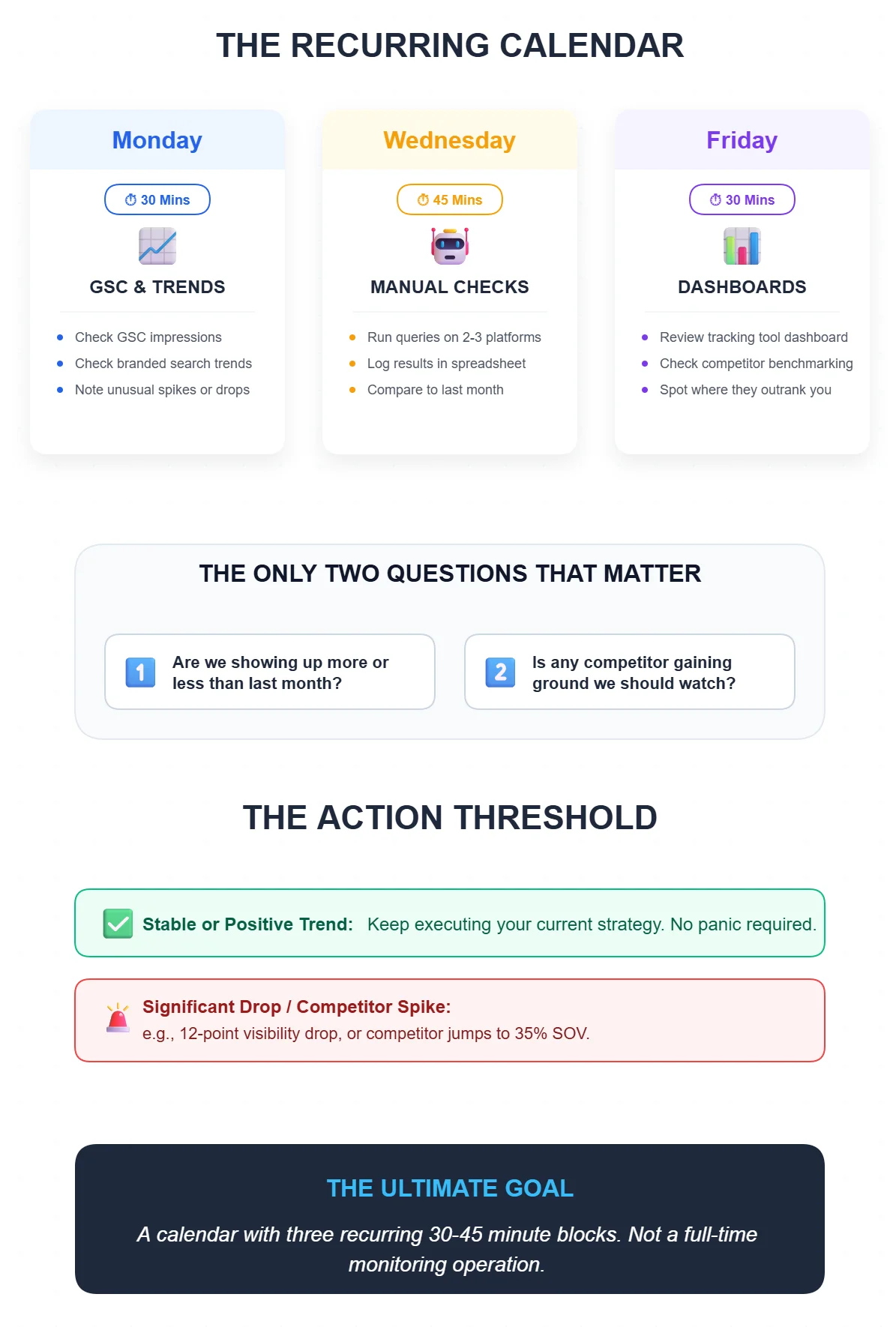
Tracking without rhythm is just random checking. Here’s a weekly workflow that takes under two hours:
- Monday (30 minutes): Check GSC impressions and branded search trends. Note any unusual spikes or drops.
- Wednesday (45 minutes): Run your manual AI checks across 2-3 platforms. Log results in your spreadsheet. Compare to last month’s checks.
- Friday (30 minutes): Review your tool’s dashboard (if using one). Look at competitor benchmarking — where are they appearing that you’re not?
That’s it. No daily obsessing. No “track everything” sprawl.
The goal each week is to answer two questions:
- Are we showing up more or less than last month?
- Is any competitor gaining ground we should pay attention to?
If both answers are stable or positive, keep doing what you’re doing.
If you see a 12-point drop in your visibility score or a competitor suddenly appearing in 35% of responses where you’re at 18%, that’s when you investigate.
What you should see: A calendar with three recurring 30-45 minute blocks. Not a full-time monitoring operation.
The Ugly Truth: What Nobody Tells You About AI Visibility Tracking
Let’s get honest about the messy parts.
| Problem | The Weird Fix | Why It Matters |
|---|---|---|
| Same prompt gives wildly different brand lists every time | Stop tracking individual prompts. Track categories of prompts (e.g., “best tools for X” as a group of 10+ variations) | Individual query volatility makes single-prompt tracking useless |
| Your tool shows visibility, but gives zero guidance on what to improve | Use cited page data to reverse-engineer what’s working. Look at your top 5 cited pages — what do they have in common? (Hint: usually structured data and clear, direct answers) | Optimization guidance is sparse in most budget tools — you’ll need to build your own feedback loop |
| Sentiment shows “negative” but the mention seems neutral | Don’t act on sentiment flags without reading the actual AI response. Sentiment analysis accuracy in these tools is unproven | False positives can trigger unnecessary content changes |
| You’re visible in ChatGPT but invisible in Gemini | Each AI engine weights sources differently. Content that performs in one may need different structural signals for another. Check your schema markup | Prompt coverage gaps across platforms are real — optimizing for one engine isn’t enough |
| Budget tools only cover 2-3 AI engines | Supplement with manual checks on the engines your tool misses. Your bi-weekly manual check covers this gap | Limited AI engine coverage in budget tools means you’re flying partially blind without manual backup |
None of these problems are fatal. They’re just the reality of a space that’s still being figured out.
The teams that win aren’t the ones with perfect data — they’re the ones who show up consistently and watch for directional shifts.
⚡ The Zero-Click Brand Lift
Don’t let flat traffic discourage you. A recent multi-channel attribution study found that brands consistently mentioned positively in AI search results see a 22% lift in direct traffic over 90 days. Even if users don’t click the citation link in ChatGPT, the brand exposure drives them directly to your domain later.
How to Know It’s Working
After 4-6 weeks of consistent tracking, you should notice a few things:
You’ll have a baseline. That’s the real win. When something changes — an algorithm update, a competitor’s content push, your own new publication — you’ll be able to see the effect instead of guessing.
You’ll also start seeing which content pillars drive your AI visibility. Maybe it’s your comparison posts.
Maybe it’s your how-to guides. That insight shapes your entire content strategy going forward.
And you’ll stop panicking about individual AI responses. Because you’ll know that a single prompt result means almost nothing, but a month of consistent patterns means everything.
FAQs
How long does it take to see AI visibility changes after publishing new content?
Most teams report 3-6 weeks before new content starts appearing in AI responses consistently. AI engines recrawl and reindex on their own schedules. Publish, wait, and track — don’t expect overnight results from a single post.
What’s the minimum budget needed for AI visibility tracking?
Zero, honestly. Google Search Console is free. Manual checks cost time, not money. If you want a dedicated tool, freemium tiers let you validate the concept before spending. Budget constraints shouldn’t stop you from starting — they should shape how you start.
Can a two-person team realistically track AI visibility?
Yes. The workflow above takes under two hours per week. One person can own it. The key is consistency, not capacity. A small team AI monitoring workflow built on proxy metrics beats a large team drowning in unused dashboards.
Does AI visibility tracking replace traditional SEO tracking?
No. It complements it. Think of traditional SEO as tracking who visits your store. AI visibility tracking is understanding who’s talking about your store. Both matter. Use them together — your content strategy should feed both channels.
What if AI tools are citing incorrect information about our brand?
This happens. Screenshot it immediately — that’s your evidence log working for you. Then update the source content on your site with clearer, more direct answers. AI systems eventually recrawl and correct, but only if your published content gives them better information to pull from.
How do I convince my manager this is worth tracking?
Start with one data point: check if your top competitor appears in ChatGPT for your most important query. If they do and you don’t, that’s the conversation starter. Frame it as competitive intelligence, not a new project. Sign up to start building trackable content and let the results make the case.
The uncomfortable truth is that AI visibility tracking is still early. The tools are young. The metrics aren’t standardized.
The data is noisy.
But that’s exactly why starting now — even imperfectly — gives you an edge.
While competitors wait for perfect solutions, you’ll have months of baseline data, a working rhythm, and a clear sense of where you stand.
Small experiments. Consistent signals. Patterns over precision. That’s the whole game.
Ready to create content that AI platforms actually want to reference?
ButterBlogs helps small teams research, write, and optimize authoritative content in minutes — the kind of content that builds the visibility signals we’ve been talking about.
✅ Automated Research
✅ SEO & AEO Optimization
✅ Scale Your Output