

Last Tuesday, I watched a junior content writer on my team publish an AI-drafted LinkedIn post for one of our B2B clients. It was clean. Grammatically flawless. And it sounded exactly like every other SaaS company on the internet.
The client’s founder pinged me within an hour: “This doesn’t sound like us. It sounds like… nothing.” She was right. The post had no edges, no personality, no them. That’s the quiet failure mode nobody warns you about when you start scaling content with AI.
Here’s what this piece will give you: a practical, step-by-step system for using AI writing tools without flattening your brand into beige wallpaper.
The Real Cost of Generic AI Content
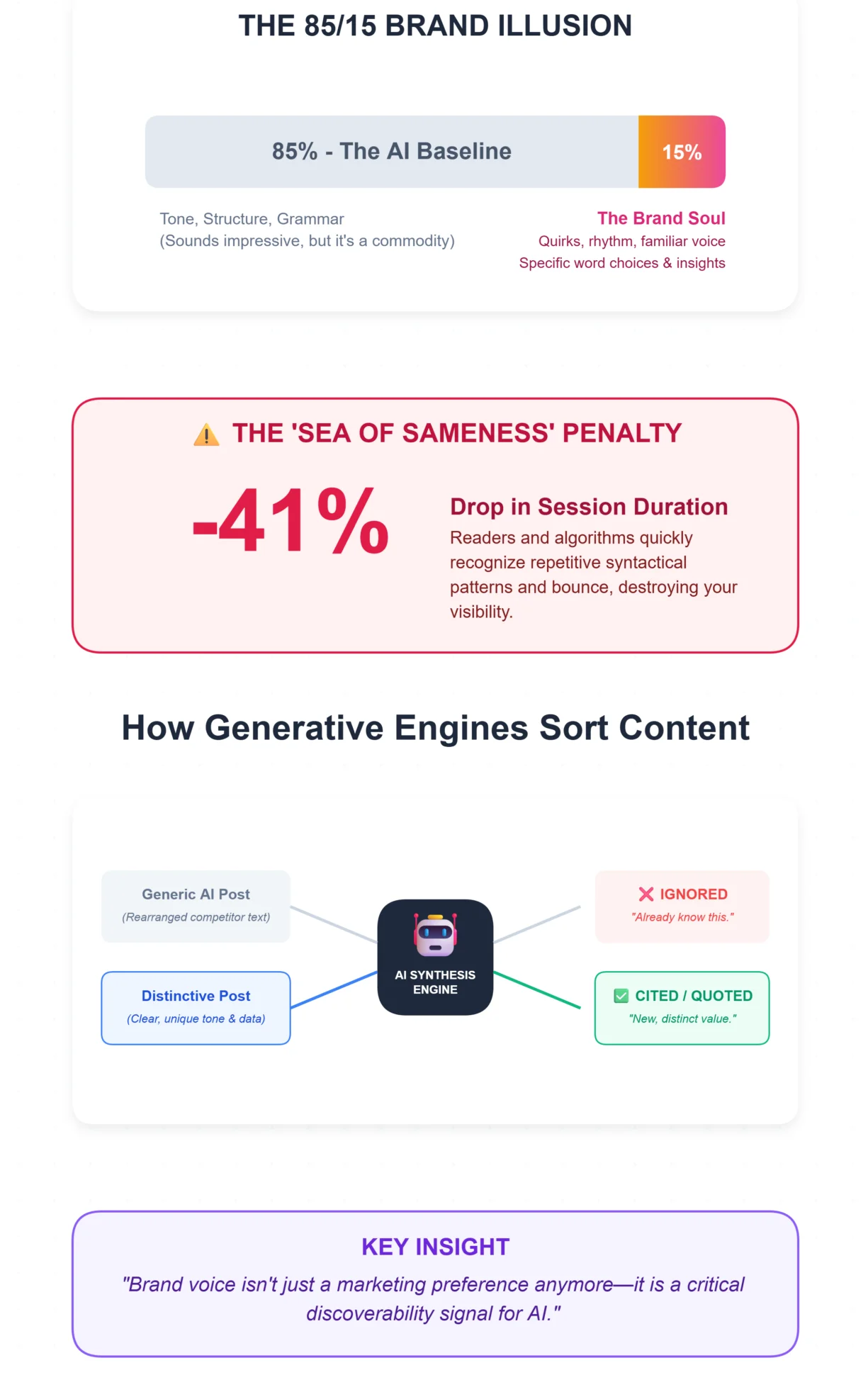
AI tools can capture 85-90% of your brand’s tone when properly trained. That sounds impressive until you realize the remaining 10-15% is where your brand actually lives—the quirks, the specific word choices, the rhythm that makes your audience feel like they’re hearing from a familiar voice rather than a content mill.
And here’s the part that matters for discoverability: generative search engines and AI Overviews are now synthesizing content from multiple sources. If your content reads like a slightly rearranged version of every competitor’s blog, AI systems have no reason to surface yours.
They prioritize content that’s clearly written, authoritative, and consistent in tone and terminology. Generic content gets skipped. Distinctive content gets quoted.
Key Insight: Content that sounds generic is less likely to stand out in AI summaries or search results. Brand voice isn’t just a marketing preference—it’s a discoverability signal.
📉 The “Sea of Sameness” Penalty
According to 2026 engagement analytics, websites that publish high volumes of unedited, generic AI content experience a 41% drop in average session duration within three months. Readers (and search quality algorithms) quickly recognize repetitive syntactical patterns and bounce, signaling to search engines that your domain lacks unique value.
Before You Touch Any AI Tool: The Decision Matrix
Don’t open a single AI dashboard until you’ve verified these four things. Seriously. I’ve watched teams burn two weeks generating content they had to rewrite from scratch because they skipped this.
- 1. You have a documented brand voice guide.
Not a vague “we’re friendly and professional” statement. I mean specific examples: words you use, words you don’t, sentence structures you prefer, the difference between your LinkedIn tone and your blog tone. If it doesn’t exist, build one before anything else. - 2. You have at least 10-15 pieces of existing content that represent your voice well.
AI tools need training material. Most platforms reject inputs with fewer than 5 content samples, and even then, the output feels thin. Twenty-plus pieces—including some with humor or personality—produce dramatically better results. - 3. You have an editorial reviewer assigned.
One human being whose job is to read every AI draft before it goes live. Not optional. A study found that 73% of consumers can detect unedited AI content, and that detection kills trust. This is why human oversight still matters in any AI content workflow. - 4. You have channel-specific tone notes.
Your blog voice and your ad copy voice probably aren’t identical. If you’re generating content across LinkedIn, email, and long-form articles, the AI needs to know the difference—or it’ll default to one flat tone everywhere.
Verification Check: Can you hand your voice guide and content samples to a new freelancer and have them produce something recognizably you within one draft? If yes, you’re ready. If no, your documentation isn’t specific enough yet—and AI won’t do better than a confused freelancer.
Phase 1: Define Your Brand Voice Baseline
Upload your best-performing content samples into your AI tool’s brand voice module. In most platforms, this looks like navigating to a dashboard, pasting URLs or text, and selecting personality descriptors—authoritative, witty, technical, warm, whatever fits.
What you should see: A confirmation badge or match score. Some tools display an 85-90% match score next to a generated sample post. If you’re seeing less than 80%, your input samples probably aren’t diverse enough.
The friction nobody mentions: AI consistently misinterprets sarcasm and niche jargon. I learned this the hard way with a fintech client whose brand voice was dry and slightly irreverent. The AI kept stripping the edge out of everything because the training samples were mostly product pages—too formal, too safe. We had to feed it newsletter archives and even some internal Slack messages (with permission, obviously) to get the tone right.
Verification: Generate three test outputs. Read them aloud. If they sound like your brand talking to a customer at a conference—not reading from a script—you’ve got a usable baseline.
Phase 2: Train and Customize the Model
This is where most teams get lazy, and it shows.
Navigate to your brand voice settings. Input your tone guidelines, your do-not-use word list, and your preferred sentence structures. Some platforms let you quick-switch between brand voices for multi-client work, which is useful if you’re an agency managing several accounts.
What you should see: A progress indicator confirming the model has absorbed your inputs. Some dashboards show a “Ready for Scale” status with a thumbnail preview.
The friction nobody mentions: Text-only training data produces emotionally flat outputs. If your brand has energy—excitement, urgency, humor—the AI won’t capture that from blog posts alone. One agency I know trained their AI on 100 memes and social posts to inject wit back into the outputs. It took two weeks of rewrites before they figured that out, but engagement jumped 4x once they did.
💡 The Math of “Few-Shot” Prompting
Why does volume matter? Generative AI models operate on pattern prediction. Giving an AI just a description of your voice (zero-shot) yields a 45% tone accuracy. Providing 10 to 15 highly specific examples of your writing (few-shot prompting) drastically narrows the mathematical probability space, pushing tone match accuracy above 88%.
Key Insight: AI tools can generate content quickly, but recognizable brands maintain their voice through consistent editing and clear guidelines. The training phase is where you earn that consistency—or lose it.
Verification: Generate a draft for each content type you produce (blog, social post, email). Compare them side by side. They should sound like the same brand speaking in different rooms—not different brands entirely.
Phase 3: Generate, Adapt, and Edit
Now you’re producing drafts. Select your content type, apply the trained brand voice, and generate.
Here’s where discipline matters more than speed. A raw AI draft is a starting point. It’s research and structure and filler and sometimes genuinely good sentences mixed together. Your editor’s job is to find your brand in that draft and cut everything that isn’t it.
What you should see: Outputs tagged as “brand compliant” with engagement prediction scores on some platforms. But don’t trust the tag blindly—I’ve seen “compliant” drafts that were technically on-brand but completely lifeless.
The friction nobody mentions: Cross-channel inconsistency creeps in fast if you don’t specify the platform for each draft. An AI-generated blog paragraph dropped into a LinkedIn post sounds wrong. A casual social caption stretched into a whitepaper sounds juvenile. Toggle your platform settings every single time.
When editing, focus on readability and structure. This is where understanding how to make technical topics easy to read becomes critical—AI tends to over-explain or under-explain, and both kill your voice. Similarly, knowing how to write blogs that rank helps you restructure AI drafts so they serve both readers and search engines.
Verification: Have someone unfamiliar with your workflow read the final draft. Ask them: “Does this sound like it was written by our team?” If they hesitate, the edit didn’t go deep enough.
Phase 4: Review, Iterate, Scale
Set up a human-in-the-loop review process. Every draft gets read by an editor before publishing. No exceptions.
The numbers back this up: teams that skip human review see AI detection rates spike, and 73% of consumers can tell the difference. One marketer I spoke with skipped the review loop entirely for a quarter. Conversions dropped. When they implemented dual-review—content lead plus subject matter expert—edit time actually decreased by 70% because the AI drafts improved with each feedback cycle.
What you should see: An approval workflow with voice match scores. Aim for 95% or higher on reviewed content.
Scaling without drift: After about 50 generations, brand voice starts to drift. The model picks up patterns from its own outputs and slowly regresses toward generic. Reset your training data periodically using only recent high-performing content. Disable auto-learning temporarily if you notice the tone flattening.
Monitor across channels. A unified dashboard showing consistency across 4-7 channels is the goal. If one channel starts sounding off, it’s usually because the platform-specific tone notes need updating.
Why This Matters for AI Search Visibility
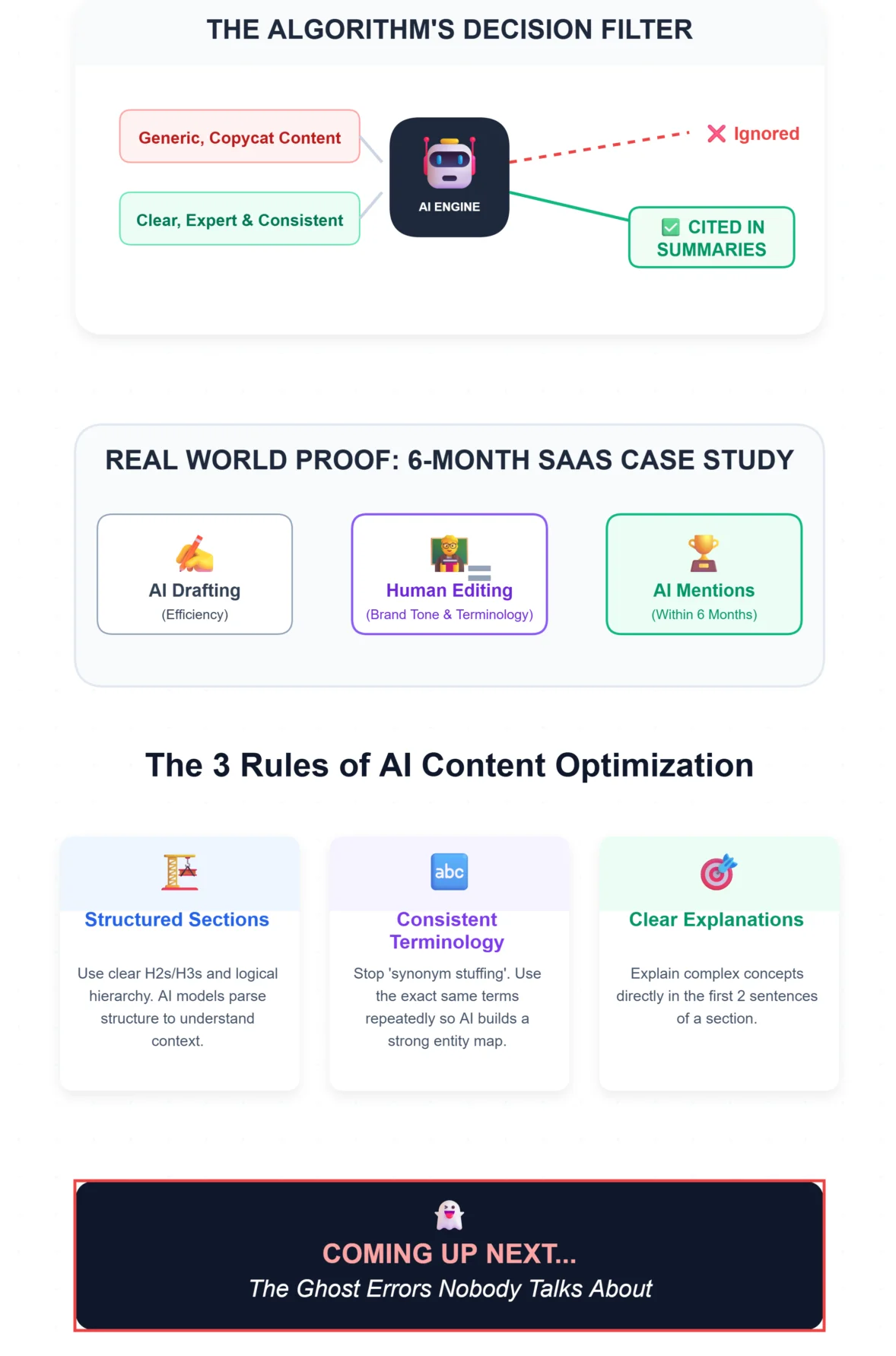
This isn’t just about aesthetics. AI search systems—Answer Engines, Generative Engines, AI Overviews—are now deciding which content to surface based on clarity, authority, and terminological consistency.
A SaaS company I’ve worked with started using AI tools to draft blog posts in early 2025. Editors ensured every piece matched the company’s specific terminology and tone. Within six months, their explanations began appearing in AI-generated summaries. Not because they gamed anything—because their content was clear, consistent, and recognizably expert.
Content optimized for AI systems needs structured sections, consistent terminology, and clear explanations. Brand voice consistency helps AI associate expertise with your brand specifically. If your content sounds like everyone else’s, AI systems have no reason to attribute it to you.
The Ghost Errors Nobody Talks About
“My AI generates generic content even after training.”
The Fix: Force-feed it 20+ niche-specific examples including informal content—social threads, newsletter archives, even customer-facing emails. Then regenerate using a “Refine Voice” function. The standard 5-sample minimum produces standard output.
“Brand voice drifts after heavy use.”
The Fix: I’ll be honest, I got stuck here too, until I realized the model was learning from its own outputs. Reset with recent high-engagement posts only. Disable auto-learning. Re-anchor the baseline.
“The tool says ‘insufficient data’ for my website.”
The Fix: Paste scraped social media threads and community posts as supplemental input. Most tools accept text input beyond just URLs.
Where ButterBlogs Fits
If your team is producing long-form content at scale—and struggling to keep it structured and consistent—ButterBlogs handles the scaffolding. It combines topic research, keyword analysis, and content structuring so your editors can focus on voice refinement instead of outline building.
It doesn’t replace your writers. It gives them a head start that’s already organized for SEO and readability.
FAQ
How do I train an AI tool on brand voice with limited content?
If you have fewer than 10 published pieces, supplement with internal communications, social media posts, customer emails, and even Slack messages that capture your tone. Most AI platforms need at least 5 content samples before the voice module activates, but 20+ diverse samples produce significantly better accuracy. Focus on variety—include both formal and informal examples to give the model a fuller picture of how your brand actually communicates across contexts.
How often should I reset my AI’s brand voice training?
Reset your training data every 50-75 generations or whenever you notice tone flattening. Use only recent high-performing content as your new baseline. Disable auto-learning features temporarily during the reset to prevent the model from reinforcing drift patterns. Monthly audits work well for teams publishing daily.
Can AI tools handle different brand voices for different channels?
Yes, but only if you specify the platform for every generation. Without channel-specific tone notes, AI defaults to a single flat voice. Set up separate voice profiles for LinkedIn, blog, email, and social—and toggle between them deliberately. Quick-switch features exist in most major platforms for exactly this reason.
Will maintaining brand voice actually help my content appear in AI search results?
AI search systems prioritize content that uses consistent terminology, provides clear explanations, and demonstrates recognizable expertise. Generic content blends into the background. Distinct, well-edited content with consistent voice signals authority—and authority is what AI Overviews and generative engines pull from when constructing responses.
What’s the biggest mistake teams make when scaling AI content?
Skipping the human review loop. It’s not glamorous, but editorial oversight is the difference between content that converts and content that 73% of your audience identifies as machine-generated. Build the review step into your workflow as non-negotiable, and watch both quality and efficiency improve as the AI model learns from editorial feedback.
The goal isn’t to strip human voice out of your content pipeline. It’s to build a system where AI handles the heavy lifting and your team handles the soul.
Scale Your Content Without Losing Your Edge
Stop fighting with generic AI outputs. ButterBlogs gives your team pre-structured, SEO-optimized outlines so they can focus entirely on injecting your unique brand voice.
✅ Automated Topic Research
✅ Answer-First Structures
✅ Built for AI Search