

I spent the first quarter of 2026 migrating a 14-person content team off a patchwork of three AI tools, two SEO platforms, and a shared Google Doc labeled “BRAND VOICE — PLEASE READ.” The subscription cost wasn’t the problem. The workflow cost was: every blog post touched six browser tabs, two people for QA, and a spreadsheet for internal links nobody updated.
That experience reshaped how I evaluate AI blog writing software. The writing is table stakes. What actually determines ROI is everything around the writing—research, SERP intent matching, brand voice governance, publishing pipeline integration, and content maintenance after you hit “publish.”
Choosing the best AI blog writing software in 2026 isn’t about who generates the fastest draft. The right platform should help you research topics, maintain a consistent brand voice, optimize for SEO, streamline publishing, and scale content production without sacrificing quality. With dozens of AI writing tools available, finding the right fit depends on your workflow, content goals, and team size.
This guide compares five leading AI blog writing platforms across the complete blogging lifecycle—not just features and pricing—so you can make a confident decision based on how you actually work.
TL;DR: Quick Verdict Matrix
How We Evaluated These Tools: The AI Blogging Lifecycle Framework
Most comparison articles score tools on features, pricing, pros, and cons. That approach misses the point. A blog post isn’t “done” when the AI finishes drafting. It’s done when it ranks, drives traffic, stays accurate, and connects to your broader content strategy.
We built the AI Blogging Lifecycle Framework™ to evaluate each tool across the 12 stages a blog post actually moves through:
No single tool covers all 12 stages perfectly. But some cover far more of the lifecycle than others—and that’s where the real differences emerge.
Quick Comparison Table
Detailed Reviews
1. ButterBlogs — Best Full-Workflow AI Blog Writing Platform
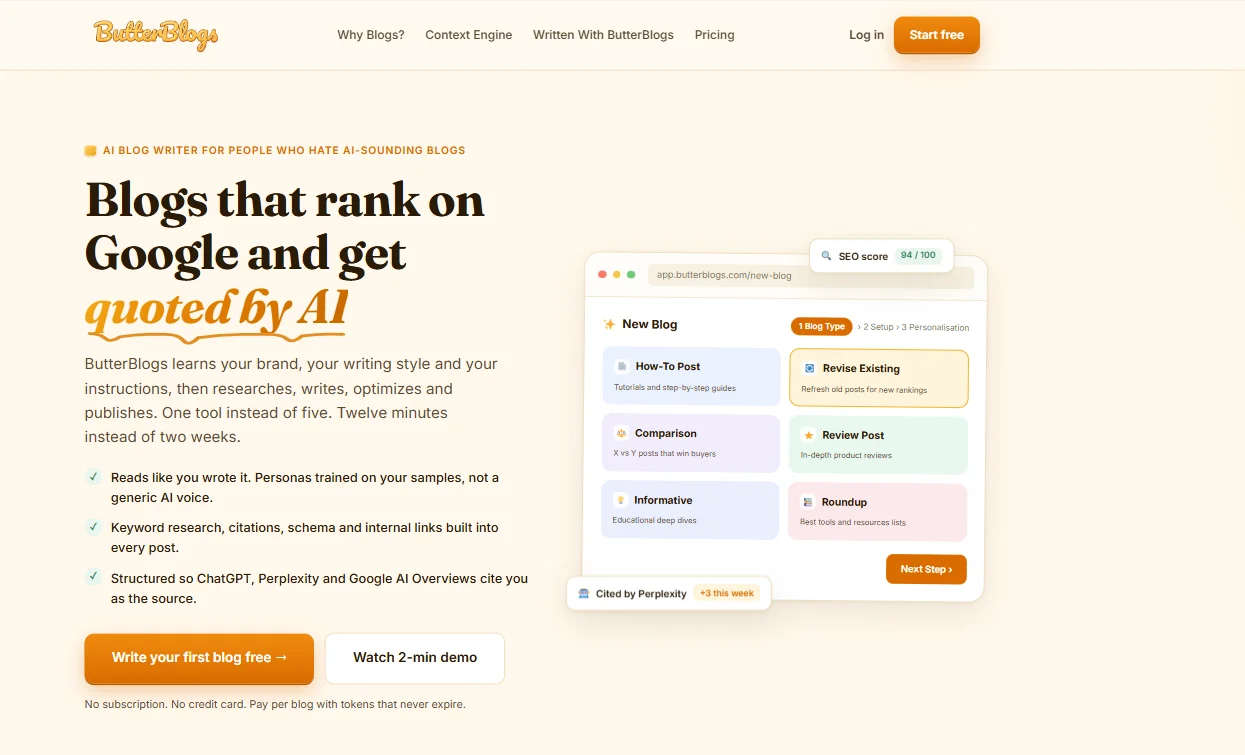
Overview: ButterBlogs is an AI-powered writing platform that combines topic research, keyword analysis, SEO optimization, internal linking, and content writing into a single publishing pipeline. Rather than handling just the drafting stage, it’s designed to cover the entire AI blogging lifecycle from idea to published post.
Best Features:
- Integrated research-to-publish workflow eliminates the need for separate SEO and writing tools
- Automated internal linking suggestions with contextual anchor text
- Brand context settings that persist across projects, maintaining tone alignment without re-prompting
- Built-in SERP analysis that shapes outlines before writing begins
- Direct WordPress publishing with formatting preserved
Pros:
- Reduces tool sprawl significantly—one subscription replaces 2–3 separate tools for most teams
- Long-form coherence is strong; posts maintain structure and depth across 2,000+ words
- SEO optimization happens during writing, not as an afterthought
- The content brief generation step alone cuts human-in-the-loop editing time noticeably
Cons:
- Smaller brand compared to Jasper or Writesonic, so the community and template library are still growing
- Enterprise-level team management features are less mature than Jasper’s
- Analytics and content refresh features are developing—not yet as deep as dedicated SEO platforms
The “Sticker” vs. “Reality” Gap: The promise of “research to publish in one place” is genuinely delivered, but the first project requires some setup time configuring brand context and preferences. Once that’s done, subsequent posts move quickly. The dashboard stays grey until your brand profile is fully synced—a small visual friction that disappears after onboarding.
Scaling Penalty: Costs remain manageable as you scale. The bigger shift is operational: a solo user gets immediate value, but a team of 10 will want clearer role-based permissions, which are still being refined.
Who Should Use It: SEO-focused content teams, agencies managing multiple client blogs, solo bloggers who want a complete workflow without juggling tools. If your goal is SEO-friendly content workflow that doesn’t require a separate brief tool, optimization tool, and publishing tool, ButterBlogs is the strongest fit.
Who Should Avoid It: Enterprise teams that need advanced governance, approval chains, and deep analytics today. Large organizations already invested in Jasper’s ecosystem.
Pricing: Starting around $29/month. See current pricing.
Final Verdict: ButterBlogs covers more of the blogging lifecycle in a single platform than any other tool on this list. For teams where the AI content workflow matters as much as the writing itself, it’s the most efficient option available.
2. Jasper — Best for Brand-Led Marketing Teams
Overview: Jasper is a premium AI content platform built for marketing teams that need strong brand voice governance, campaign-level organization, and enterprise collaboration features. It’s positioned less as a “blog writer” and more as a marketing content system.
Best Features:
- Brand voice profiles with detailed style, tone, and audience controls
- Campaign-level content organization
- Enterprise team management with roles and permissions
- Integration ecosystem including Surfer SEO, Webflow, and others
- Template library covering dozens of marketing content types
Pros:
- Brand voice governance is the strongest in this comparison—ideal for agencies managing multiple client voices
- Team workflows are mature and well-designed for content operations at scale
- The document editor handles long-form content well with section-by-section generation
- Strong ecosystem of integrations extends functionality
Cons:
- Pricing is significantly higher than alternatives, especially as team seats increase
- SEO optimization requires third-party integrations rather than being native
- The platform can feel over-engineered for users who just need blog posts
- Setup time is considerable before the first usable draft
The “Sticker” vs. “Reality” Gap: Jasper markets itself as an all-in-one marketing platform, but blog-specific SEO workflows still require connecting external tools. The guided workflow produces consistent brand voice across assets—that part works. But if you’re a solo blogger who just wants a draft, the setup overhead feels disproportionate.
Scaling Penalty: This is where Jasper gets expensive. Moving from a solo seat to a team of 10 can multiply costs quickly. The 3-year TCO for a mid-size team is substantially higher than alternatives. Community feedback on G2 and Reddit frequently mentions “paying for workflow, not raw writing.”
Who Should Use It: Marketing teams at established companies, agencies needing brand voice governance across multiple clients, enterprises with existing content operations infrastructure. If you already have an AI editorial workflow and need to standardize it across a large team, Jasper handles that well.
Who Should Avoid It: Solo founders, budget-conscious bloggers, anyone who doesn’t need team-level governance. If your primary goal is SEO blog production rather than broad marketing content, the premium pricing is hard to justify. (See our ButterBlogs vs Jasper comparison for a detailed breakdown.)
Pricing: Starting around $49/month for the Creator plan; Business plans are custom-priced.
Final Verdict: Jasper is the right choice when brand consistency and team governance are your top priorities—and when budget isn’t the primary constraint.
3. Writesonic — Best Budget-Friendly Blog Writer
Overview: Writesonic offers AI blog writing with built-in SEO features at a price point that undercuts most competitors. It’s a practical choice for bloggers and small marketing teams who want decent output quality without a large investment.
Best Features:
- Native SEO scoring and keyword suggestions during writing
- Article Wizard workflow that guides users from topic to draft
- WordPress integration for direct publishing
- Multiple AI model options for different output styles
- Competitive pricing with a generous free tier
Pros:
- Lowest barrier to entry among the five tools compared here
- Blog drafting quality is solid for standard-length posts (800–1,500 words)
- SEO features are built in rather than requiring add-ons
- The interface is straightforward—minimal onboarding friction
Cons:
- Long-form coherence drops noticeably beyond 1,500 words; posts can become repetitive
- Brand voice controls are basic compared to Jasper or ButterBlogs
- Internal linking is manual—no automated suggestions
- Research and SERP analysis features are surface-level compared to Frase
The “Sticker” vs. “Reality” Gap: The “Article Wizard” sounds like a complete workflow, but it’s more of a guided draft generator. You still need to do your own keyword research and competitive analysis externally. The SEO score is helpful but doesn’t replace a proper content brief.
Scaling Penalty: Costs stay reasonable as you add volume, but the editing cost scales. Because long-form coherence and brand voice are weaker, teams producing 20+ posts per month will spend more time on human-in-the-loop editing.
Who Should Use It: Solo bloggers on a budget, freelancers producing client content at volume, small businesses publishing 4–8 posts per month who need “good enough” output quickly.
Who Should Avoid It: Agencies needing consistent brand voice across clients, SEO teams requiring deep SERP analysis, anyone producing long-form thought leadership content.
Pricing: Free tier available; paid plans starting around $19/month.
Final Verdict: Writesonic is the strongest value pick for bloggers who prioritize cost control and speed over depth. It handles the writing stage well but leaves most of the lifecycle to you.
4. Copy.ai — Best for Content Repurposing and Workflow Automation
Overview: Copy.ai has evolved from a short-form copywriting tool into a workflow automation platform. Its strength isn’t blog writing per se—it’s turning one content brief into multiple formats across channels using automated workflows.
Best Features:
- Workflow automation engine that chains multiple content tasks together
- Brand voice profiles with style and audience settings
- Multi-format output: blogs, emails, social posts, ad copy from a single brief
- Team collaboration with shared workflows
- Free tier with generous usage limits
Pros:
- Workflow automation is genuinely useful for teams producing content across multiple channels
- The free tier is one of the most generous available
- Brand voice controls are more developed than Writesonic’s
- Good for teams that need volume across formats, not just blogs
Cons:
- Blog-specific quality lags behind ButterBlogs, Jasper, and Frase for SEO-focused long-form
- SEO optimization is minimal—no SERP analysis, no content scoring, no internal linking
- The workflow builder has a learning curve; initial setup takes time
- Long-form blog posts often need significant editing to feel cohesive
The “Sticker” vs. “Reality” Gap: Copy.ai’s marketing emphasizes “workflows that run themselves,” but building effective prompt chaining sequences requires experimentation. The first workflow takes longer to set up than expected. Once built, though, it does save time on repetitive multi-format production.
Scaling Penalty: The platform handles volume well—that’s its strength. But scaling blog quality is the issue. As you produce more blog content, the editing burden increases because the tool doesn’t have the SEO and structural scaffolding that purpose-built blog platforms offer.
Who Should Use It: Content ops teams that produce across multiple channels (blog + email + social), marketing teams that value workflow automation over SEO depth, organizations where blog content is one output among many.
Who Should Avoid It: SEO-focused teams, anyone whose primary goal is ranking blog content, solo bloggers who only need blog posts.
Pricing: Free tier available; Pro plans starting around $36/month.
Final Verdict: Copy.ai is the right tool if your content strategy is multi-channel and you need automation across formats. For dedicated blog writing and SEO, other tools on this list are stronger.
5. Frase — Best for SEO Research and Content Briefs
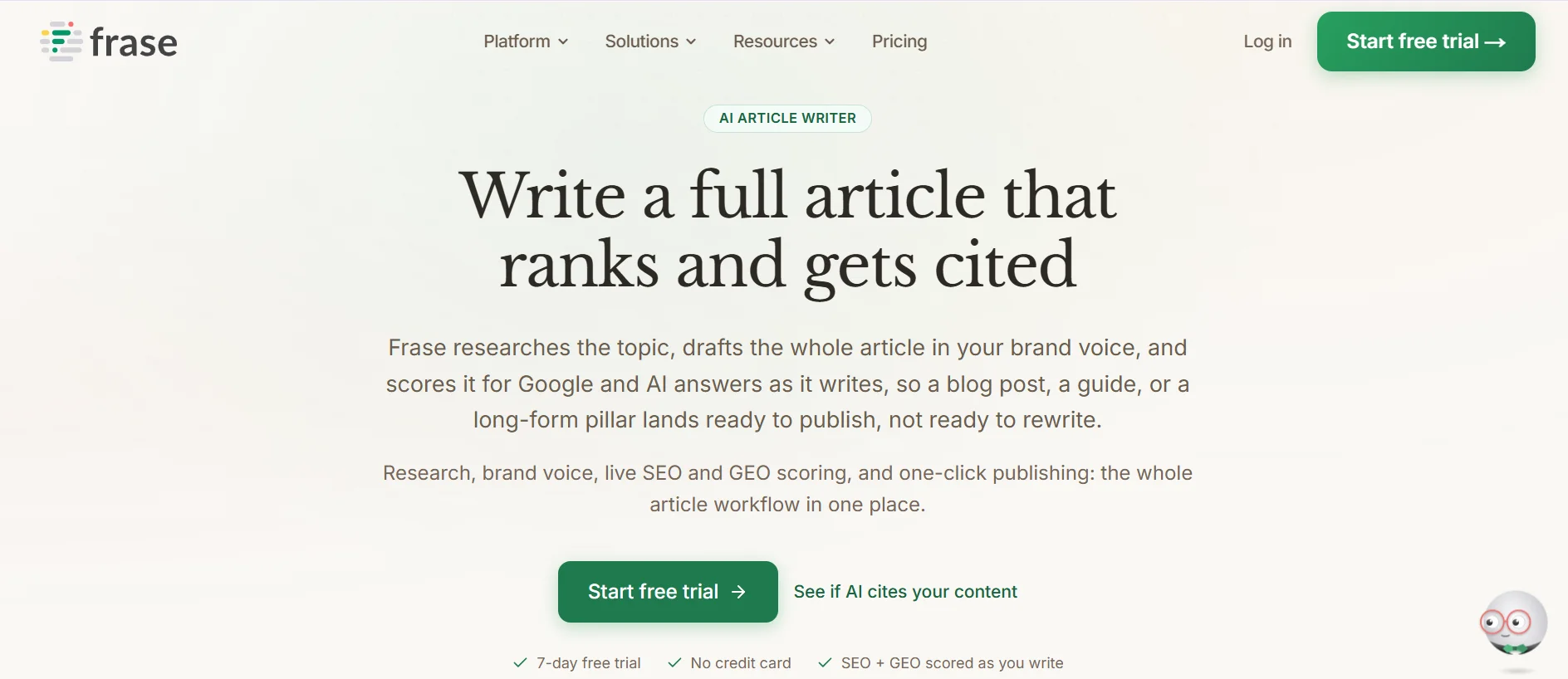
Overview: Frase approaches AI blog writing from the research side. Its core strength is SERP analysis, content brief generation, and optimization scoring—the stages that happen before and during writing rather than the drafting itself.
Best Features:
- Deep SERP analysis that breaks down competitor content structure, topics, and entity coverage
- Automated content brief generation with suggested headings, questions, and statistics
- Real-time content optimization scoring as you write
- “People Also Ask” and question research integration
- Topic clustering for content strategy planning
Pros:
- The strongest research and brief generation tool in this comparison
- Content optimization scoring is practical and well-calibrated
- Forces a research-first approach that improves output quality regardless of which AI writes the draft
- Pricing is accessible for solo SEO practitioners
Cons:
- The AI writing quality itself is weaker than ButterBlogs, Jasper, or even Writesonic
- No brand voice governance—tone alignment is entirely manual
- Publishing integration is limited; it’s primarily an editor, not a publishing pipeline
- Internal linking is manual with no automated suggestions
- Team collaboration features are basic
The “Sticker” vs. “Reality” Gap: Frase markets itself as a “write and optimize” platform, but most practitioners use it for the research and brief stages, then draft elsewhere. The writing AI is functional but not the reason to buy. The progress bar on optimization score is genuinely useful—watching it shift from red to green as you improve entity coverage is one of the better visual checkpoints in any SEO tool.
Scaling Penalty: Frase stays affordable per seat, but it doesn’t replace a writing tool. So at scale, you’re paying for Frase plus a drafting tool, which increases your overall stack cost and workflow complexity.
Who Should Use It: SEO professionals who build detailed content briefs before writing, content strategists who want data-driven outlines, teams that already have a preferred writing tool and need a research layer on top. If you’re building an AI content system where research and writing are handled by different tools, Frase is the best research half.
Who Should Avoid It: Anyone who wants a single tool for the full blogging lifecycle, teams without SEO expertise to interpret SERP data, bloggers who just want to type a topic and get a draft.
Pricing: Starting around $15/month for the Solo plan.
Final Verdict: Frase is indispensable for SEO research and content brief generation. But it’s a complement to a writing tool, not a replacement for one.
AI Blog Software Evaluation Matrix: Scored Comparison
Scores reflect lifecycle coverage, not just writing quality. A tool can write well but score lower overall if it leaves major lifecycle stages unaddressed.
Choosing the Right Tool: Decision Tree
If you’re an agency managing multiple client blogs → ButterBlogs gives you the most lifecycle coverage per dollar. Jasper is the alternative if brand governance and enterprise team management are your primary requirements.
If you’re a startup publishing 8–15 blogs per month → ButterBlogs handles the full workflow without tool sprawl. Writesonic is the fallback if budget is the top constraint.
If you’re a solo blogger on a tight budget → Writesonic offers the best value for straightforward blog drafting. Pair it with Frase if you want stronger SEO research.
If you’re an SEO team building content briefs → Frase is the research layer. Combine it with ButterBlogs for the writing and publishing stages to cover the full lifecycle.
If you’re a large marketing team producing multi-channel content → Jasper for brand governance and team management, or Copy.ai if workflow automation across formats matters more than blog-specific quality.
Already narrowing your options?
We built ButterBlogs to handle the research, writing, SEO, and publishing stages in one place—so you don’t have to stitch together three tools. Start a free trial and see how the full workflow compares to your current setup.
Frequently Asked Questions
What is AI blog writing software?
AI blog writing software uses large language models to help users research, draft, optimize, and publish blog content. The best platforms go beyond drafting to include SEO optimization, brand voice controls, and publishing integrations—covering the full content production lifecycle rather than just generating text.
Can AI write SEO-optimized blog posts?
Yes, but quality varies significantly by tool. Platforms like ButterBlogs and Frase build SEO into the workflow—structuring content around search intent, entity coverage, and heading optimization during writing. General-purpose AI like ChatGPT can draft content but requires manual SEO optimization afterward.
Is ChatGPT enough for blog writing?
ChatGPT is strong for brainstorming, outlining, and drafting, but it lacks built-in SEO workflows, internal linking, brand memory, and publishing integration. Most teams that start with ChatGPT eventually add 2–3 other tools to cover the full lifecycle. (We break this down in our AI Blog Writer vs ChatGPT comparison.)
Which AI tool writes the most human-like blog content?
Claude and ButterBlogs consistently produce the most natural-sounding long-form content. Claude excels at tone and nuance in raw drafting. ButterBlogs combines natural writing quality with SEO structure and brand context, which reduces the edit burden for publish-ready output.
Which AI blog writing software is best for WordPress?
ButterBlogs and Writesonic both offer direct WordPress publishing with formatting preserved. ButterBlogs handles the full workflow from research to publishing natively, while Writesonic covers the drafting and basic SEO stages.
Which AI writing tool is best for agencies?
For agencies, the priority is usually brand voice governance across clients, team collaboration, and workflow efficiency. ButterBlogs is the strongest fit for agencies focused on SEO blog production. Jasper is the alternative for agencies that need broader marketing content governance.
How much does AI blog writing software cost?
Pricing ranges from free tiers (Copy.ai, Writesonic) to $49+/month (Jasper). ButterBlogs starts around $29/month. Frase starts at $15/month. The real cost consideration is 3-year TCO: cheaper tools with weaker SEO and editing capabilities often cost more in human editing time.
What’s the difference between AI blog writers and AI copywriting tools?
AI blog writers are optimized for long-form coherence, SEO structure, and topical depth. AI copywriting tools (like Copy.ai’s original positioning) focus on short-form: ads, emails, social posts. Some tools, like Copy.ai and Jasper, now span both categories, but their blog-specific capabilities vary.
Do AI blog posts rank on Google?
They can, but only when properly optimized. Google’s guidelines focus on content quality and helpfulness, not whether AI was involved. Posts that rank typically go through SERP analysis, proper heading structure, entity coverage, internal linking, and human review—stages that purpose-built platforms handle better than general AI.
Can AI maintain brand voice across blog posts?
Yes, if the tool supports brand voice governance. Jasper has the most detailed brand voice profiles. ButterBlogs maintains brand context per project. Writesonic and Copy.ai offer basic tone controls. Frase and ChatGPT require manual tone guidance with every prompt.
What is the AI Blogging Lifecycle?
The AI Blogging Lifecycle is a framework for evaluating blog writing tools across 12 stages: topic research, keyword planning, SERP analysis, content brief, brand context, writing, SEO optimization, internal linking, publishing, content refresh, team collaboration, and analytics. Writing is only one stage—tools that cover more of the lifecycle reduce total production cost.
Should I use one AI tool or combine multiple?
It depends on your workflow. A single-platform approach (like ButterBlogs) reduces tool sprawl and switching costs. A multi-tool stack (like Frase + ChatGPT + WordPress) offers more flexibility but adds workflow complexity. Teams producing 10+ posts per month generally benefit from consolidation.
How do I evaluate AI blog writing software for my team?
Use the AI Blog Software Evaluation Matrix: score each tool on research, planning, SEO, content quality, brand memory, internal linking, publishing, collaboration, scalability, and maintenance. Weight each category based on your team’s priorities. A tool that scores 9/10 on writing but 3/10 on publishing may cost you more in total workflow time.
Final Thoughts
There’s no single “best” AI blog writing software—there’s only the best fit for how you work.
If you need the most complete blogging workflow in one platform, covering research through publishing and internal linking, ButterBlogs handles more of the lifecycle than any other tool in this comparison. If brand governance and enterprise team management are your priority, Jasper is the premium choice. If you’re optimizing for budget, Writesonic delivers solid blog output at the lowest cost. If your content strategy is multi-channel, Copy.ai’s workflow automation stands out. And if you want the deepest SEO research layer, Frase is hard to beat as a complement to your writing tool.
The one thing I’d push back on is evaluating any of these tools based on writing quality alone. Writing is one step. The tools that save you the most time and produce the best results are the ones that cover the stages you’re currently handling manually—research, optimization, linking, publishing, and maintenance.
Pick the tool that fills the biggest gap in your current workflow, not the one with the longest feature list.
Ready to see the full workflow in action?
Try ButterBlogs free and compare it against your current process. Most teams see the difference within their first published post.