
A few years ago, the playbook was dead simple. You published consistently, targeted long-tail keywords, and watched organic traffic climb. More posts meant more indexed pages, more keyword coverage, more chances to rank.
That world doesn’t exist anymore.
Today, businesses are publishing more blog posts than ever—and many are staring at dashboards showing stagnant traffic, declining clicks, and ROI that’s quietly evaporating. The rules of search changed underneath us. AI-generated content flooded every niche. AI Overviews started answering queries before anyone clicked. And content saturation fundamentally broke the old volume-equals-growth equation.
So why is publishing more no longer enough? And what actually works now?
By the end of this guide, you’ll understand exactly why the old content playbook broke, what replaced it, and how to build a content strategy that actually drives traffic in 2026.
Quick Answer: Why Publishing More Blog Posts No Longer Guarantees More Traffic
- Content saturation increased dramatically. The internet now has more content than search engines need.
- AI-generated content flooded search results. Thin differentiation became the norm.
- Search engines now prioritize topical authority and trust over publishing frequency.
- AI Overviews reduce organic clicks. Many queries never generate a visit.
- Search intent matters more than volume. Misaligned content won’t rank regardless of quantity.
- Modern SEO rewards structure, relevance, and expertise — not just output.
“Search engines no longer reward content volume alone. They reward relevance, structure, and expertise.”
The Old Content Marketing Playbook
For years, the dominant SEO advice was straightforward:
- Publish frequently.
- Target as many long-tail keywords as possible.
- Scale output.
- More indexed pages = more traffic.
And honestly? It worked. Search engines had a content supply problem. There weren’t enough quality pages to satisfy every query, so sites that published consistently earned crawl frequency advantages, broader keyword coverage, and compounding organic growth. One widely cited analysis found companies that kept blogging saw an 85.8% increase in organic traffic over 12 months. The math was simple: more content, more surface area, more clicks. But that math assumed a world where supply hadn’t caught up with demand. That assumption broke.
What Changed in 2026
This is the part most content strategies haven’t caught up with.
- AI-generated content exploded. Every business, freelancer, and content farm gained access to tools that could produce articles in minutes. The volume of new content published daily increased by orders of magnitude. The supply side of search became grotesquely oversaturated.
- AI search changed how results work. Google’s AI Overviews and generative search features now synthesize answers directly in the SERP. Many queries—especially informational ones—became zero-click searches. Users get what they need without ever visiting your site.
- Semantic ranking systems matured. Search engines stopped evaluating pages in isolation. They started assessing whether a site demonstrates genuine depth on a topic—topical authority—rather than just matching individual keywords.
- User behavior shifted. Readers became more skeptical of generic content. Engagement signals—time on page, scroll depth, return visits—started reflecting that skepticism.
The key insight here: the internet now has more content than search engines need. Publishing another article doesn’t fill a gap anymore. It competes with thousands of nearly identical pieces for shrinking click-through rates.

Why Content Volume Alone Fails Now
I’ve watched sites publish 100+ blog posts in a quarter and see their organic traffic actually decline. Here’s why that happens:
- Weak differentiation. When your article says exactly what 47 other articles say, there’s zero information gain. Search engines have no reason to rank it.
- Generic AI content. AI-generated posts without original insight read like slightly reshuffled versions of existing top results. They add noise, not value.
- Thin topical coverage. Publishing across 30 unrelated topics signals breadth without depth. Search engines notice.
- Poor internal linking. New posts that receive zero links from existing high-authority pages on your site never accumulate enough relevance to rank.
Here’s the part that stings: publishing more low-context content can actually dilute topical authority. You’re spreading your site’s relevance thinner across more pages, and search engines interpret that as a weaker signal—not a stronger one. Content pruning exists for a reason. Sometimes removing pages improves rankings.
What Actually Drives Traffic Now
- Topical Authority
Depth beats breadth. Search engines reward sites that cover a subject thoroughly. Build clusters of interconnected content. - Search Intent Alignment
Content must solve the exact problem. If someone searches “why is my blog traffic dropping,” they don’t want a generic overview of SEO—they want specific diagnostic steps. - AI-Search Optimization
AI Overviews decide which content to surface based on semantic structure and entity clarity. - Content Structure
Structuring posts for AI Overviews is now a baseline requirement.
The Rise of “Content Systems”
Winning websites don’t operate on random publishing schedules anymore. They run structured content ecosystems—interconnected networks of pillar pages, supporting clusters, and semantic relationships that reinforce each other. Think of it like architecture. A random pile of bricks isn’t a building. A content system arranges every piece intentionally. This is why choosing the right blog topics matters more than choosing more topics.
Real Example: High-Volume Blog vs. Strategic Content System
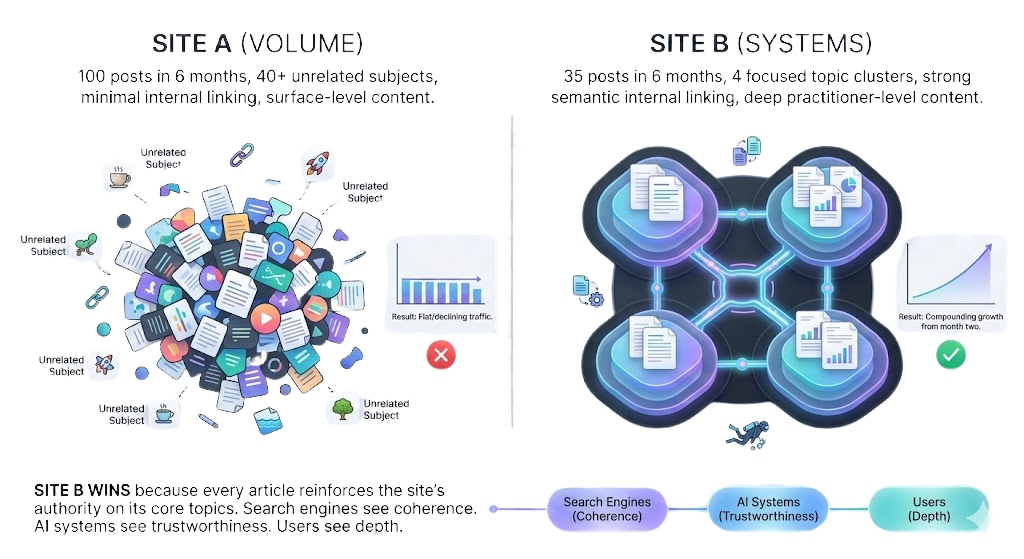
- Site A (Volume): 100 posts in 6 months, 40+ unrelated subjects, minimal internal linking, surface-level content. Result: Flat/declining traffic.
- Site B (Systems): 35 posts in 6 months, 4 focused topic clusters, strong semantic internal linking, deep practitioner-level content. Result: Compounding growth from month two.
Site B wins because every article reinforces the site’s authority on its core topics. Search engines see coherence. AI systems see trustworthiness. Users see depth.
How ButterBlogs Helps
ButterBlogs is designed to help you build these structures efficiently. Through structured topic clustering, AI-friendly formatting, and semantic consistency, it helps teams write blogs that actually rank. If you’re auditing your blog for AI search readiness, keep in mind that structured workflows matter more than individual post optimization. The shift from volume-based to systems-based content creation requires tooling that understands semantic relationships, not just word count.
Ready to systematize this?
ButterBlogs combines topic research, SEO optimization, and structured content workflows in one platform—so every article you publish is built for both traditional search and AI citation readiness.
Frequently Asked Questions
Does publishing more blog posts help SEO?
Publishing more posts can help SEO only if each post targets a validated search query, aligns with user intent, and fits into a coherent topical structure. Volume without strategic intent often dilutes authority and wastes crawl budget.
Why is my blog traffic not growing?
The most common causes are content that doesn’t match search intent, topics with no search demand, weak internal linking, and lack of topical authority. Audit whether your content answers the right questions and builds semantic coherence across your site.
Is content quantity still important in 2026?
Content quantity matters as a baseline for topical authority. But beyond that minimum threshold, additional posts only help if they deepen existing clusters, target validated queries, and add original insight.
How does AI search affect blog traffic?
AI search reduces organic clicks through AI Overviews and generative results that answer queries directly in the SERP. Content that isn’t structured for AI citation becomes invisible to a growing share of searches.
What matters more than publishing frequency?
Topical authority, search intent alignment, internal linking architecture, content depth, and original expertise all matter more than how often you publish.
What is a content system in SEO?
A content system is a structured ecosystem of interconnected content—pillar pages, supporting cluster articles, and semantic internal links—organized around core topics to build topical authority and compound organic growth.